
Climate ratings that can be verified: our contribution to EmpCo
Together with ESFC we built a rulebook, a sampling approach for daily-changing menus, and the technology to recompute a rating from recipe to result. What that means for the coming independent assessment and for CO₂ values and ratings.
Climate ratings that can be verified: our contribution to EmpCo
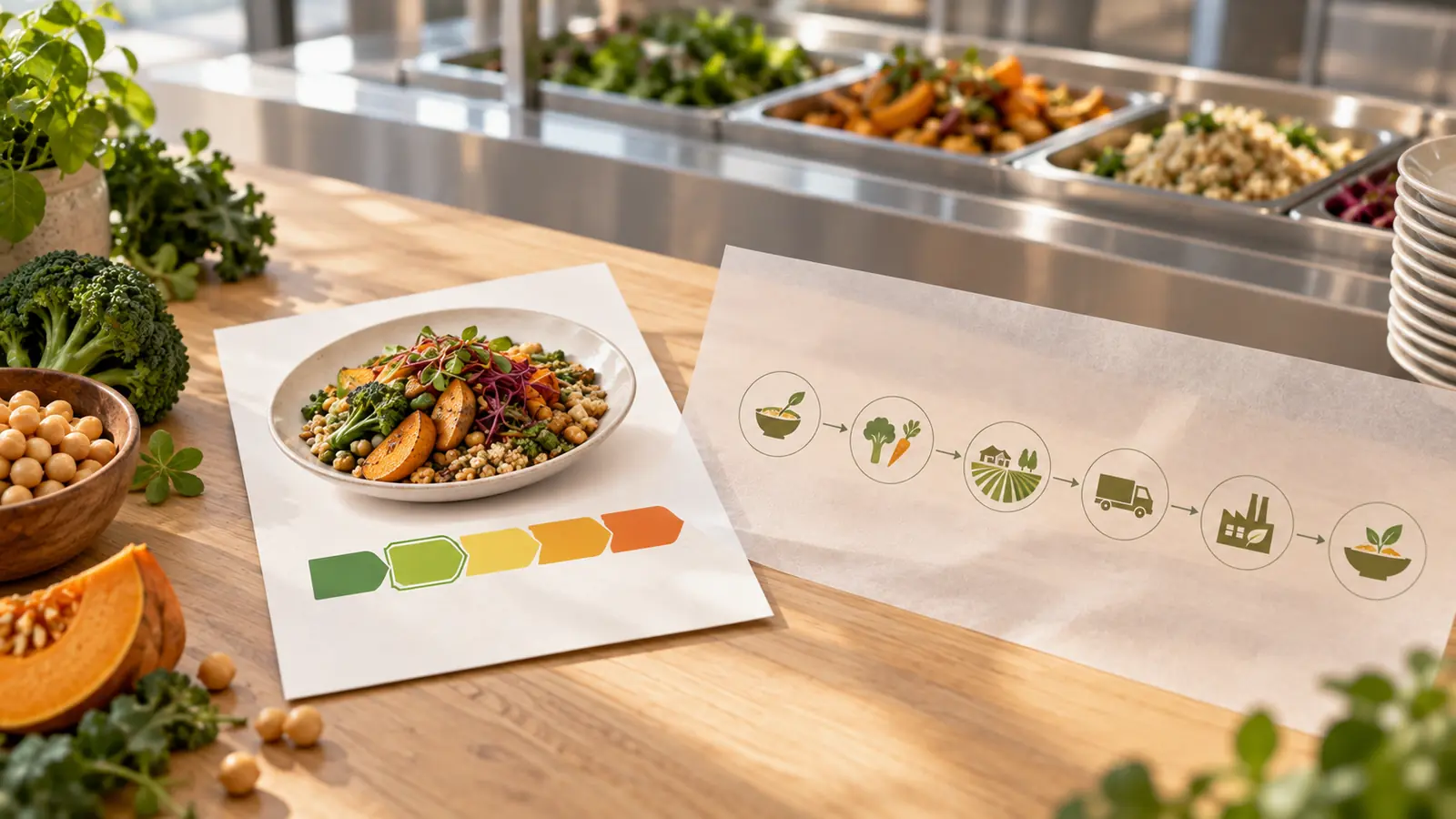
A letter next to a dish – a "B" on the scale from A to E – compresses an extensive calculation into a single symbol. Behind it are ingredients, origin, agriculture, processing, transport and preparation. Whether that symbol deserves trust comes down to one question: can someone other than us trace it — every data source, every assumption, every step of the calculation — and arrive at the same result?
From 27 September 2026, the rules of EU Directive 2024/825 on empowering consumers for the green transition, EmpCo for short, apply. Sustainability labels are then permitted only if they rest on a certification scheme with independent assessment. We welcome this. For our sector, where thousands of recipes and menus change every day and have to be calculated as they change, no such scheme existed. Over the past months we have worked to make sure one exists – and that our ratings hold up under it.
Open calculation system, open data
Before anyone can assess our ratings, they must be able to recompute them. So we revised our foundations and opened them: as one of the first providers of climate ratings for food we made our calculation system public back in 2022; since the end of August the new data basis is published as well, making the path end to end traceable (first data release: v1.8.0 with 1,066 inventories, 27 August 2026, see lci-workbench). It builds on the UVEK/BAFU life-cycle inventories — and goes beyond them: every value is derived from freely accessible data and documented models, carries a confidence, and can be recomputed independently. That simplifies the assessment and is what makes a harmonised European calculation basis possible at all.
What was built for it is in the changelog: more than 70 publicly documented building blocks for transport, fertilisers, packaging, land use and the individual product groups, process-based emission models for agriculture instead of adopted averages, a confidence on every emission flow, and a quality system with 600 test cases. The test results are open to inspection.
The yardstick behind the rating is disclosed as well: how the reference unit (Daily Food Unit) is used and how the benchmark is derived from purchasing data of contract catering (derivation of the benchmark (provisional)). The entry point to all of it is the documentation portal.
Rules that work in a real kitchen
An assessment scheme has to give clear answers: which environmental impact is assessed, which data are admissible, how a calculation becomes a rating, who checks, and what happens when data change or a rating is challenged. For these questions we drafted a rulebook and brought it into the joint development with the European Sustainable Food Coalition (ESFC). ESFC is the scheme owner: it develops, publishes and maintains the scheme. Decisions on label licences rest with its Certification Committee, whose members are appointed by the ESFC board for three-year terms and may hold no commercial interest in licence outcomes – not at a provider such as Eaternity, not at the assessment body and not at a trader. Rulebook (v1.1), fee schedule and status are on the ESFC transparency portal.
The real difficulty lay elsewhere. In a kitchen, recipes, suppliers and quantities change continuously; an assessment that checks every single dish in advance is not practicable. Our approach therefore combines two things. First, the method and the calculation process are assessed as a whole. Then an independent assessment body examines, by sampling, how the system is applied in everyday operation: randomly selected dishes for broad control, complemented by a risk-based selection for particular assumptions, new data or results close to a rating threshold. For each selected dish, the body follows the path from the recipe to the rating visible on the menu. Selection and conclusion rest with the body.
Where the assessment stands
Our method and documentation work is guided by ISO 14040/14044 for life-cycle assessment and ISO 14067 for product carbon footprints; the external assessment is carried out by independent assessment bodies working to ISO/IEC 17029 and ISO 14065. The independent assessment is engaged: Bureau Veritas Solutions Denmark A/S assesses our methodology and our rating method under ISO 14064-3 against ISO 14067 and the ESFC EmpCo Rulebook; Bureau Veritas signed its declaration on 15 September 2026.
One thing needs saying plainly: on 27 September, the assessment statement will not yet exist. The assessment is set up as an ongoing process: an initial assessment, then annual sample checks of real ratings. As soon as the assessment report exists, we publish it on the assessment status page; the assessment statement will not be issued under accreditation, and no licence under the scheme exists yet. The assessment body assesses, under its own assessment programme, our methodology, our system and a sample of real customer cases, and issues a public assessment statement with conditions for communication. At every point in time we describe the assessment status of our ratings exactly as it is. The assessment body is responsible for its conclusions; this article does not replace an assessment result.
What this means for your values
The new data basis can pave the way to a European standard for the carbon labelling of food: we are moving all our calculations onto it. Your values will then, for the first time, rest on data and models that anyone can inspect and recompute. Added to this are the reference unit Daily Food Unit (DFU) in its updated 2026 definition and the EF 3.1 assessment method. That is why we also recalculate the rating benchmark, and why CO₂ values and ratings can shift even for unchanged recipes. Such a calculated change describes the updated assessment basis; it says nothing about the actual emissions of your dishes. Values and rating thresholds switch together; we announce the date of the switch to you in good time beforehand. The main changes for your menu planning are in the blog post Upcoming update of the carbon data basis, the inventory details per food group with before-and-after values in our changelog; the complete EDB changelog lists every inventory of the data release.
We invite experts, assessment bodies and partners to examine and develop this work. The public documentation is the entry point; for exchange, reach us at hello@eaternity.org.
Ready to Transform Your Food Impact?
Discover how Eaternity can help your organization achieve sustainability goals.
Get Started