The Forest That Never Grew Back
Seven tonnes. One lever. Half of food's climate cost is currently uncounted — and it happens to sit under soil that used to be forest. A 2018 paper in Nature put a number on what the labels leave out, and the number is bigger than flying, driving and heating combined.
The Forest That Never Grew Back
Almost every hectare of farmland in the world used to be something else. Before it was a cornfield, it was a forest. Before it was a soy field, it was a savannah. Before it was a pasture, it was a wetland or a woodland storing several times more carbon in its soils and trunks than it does today. When we cleared it to grow food, we didn't just add emissions to the atmosphere — we subtracted a carbon sink, and then quietly forgot to count what we'd lost. A 2018 paper in Nature added it back up. The number is roughly half of the personal climate footprint of anyone eating a typical northern European or North American diet[1]. And it's recoverable.
What was never counted
Four researchers — Tim Searchinger, Stefan Wirsenius, Tim Beringer and Patrice Dumas — proposed a simple correction to the arithmetic of food and climate, and called it the Carbon Benefits Index[1].
Their argument is this. The standard Life Cycle Assessment that sits behind every climate label on every supermarket shelf measures the emissions of producing food — methane from cattle, diesel from tractors, nitrous oxide from fertiliser. That accounting is real, useful, and globally standardised. It is also incomplete, because it never asks what the land could have been if we weren't using it to grow food. For most of the land humans farm, the answer is a forest, a wetland, or a grassland storing several times more carbon than the field that replaced it. That gap between what the land holds today and what it could hold if released is what Searchinger and colleagues call the carbon opportunity cost.
Put a number on it and the picture of food and climate stops looking familiar. Beef and dairy, measured this way, come out three to four times heavier than the figures the United Nations Food and Agriculture Organization has been citing for years. A typical northern European diet, properly counted, produces "as many emissions as all other consumption by that person, including energy." Not a slice of the footprint. Half of it.
A chart of the recoverable half
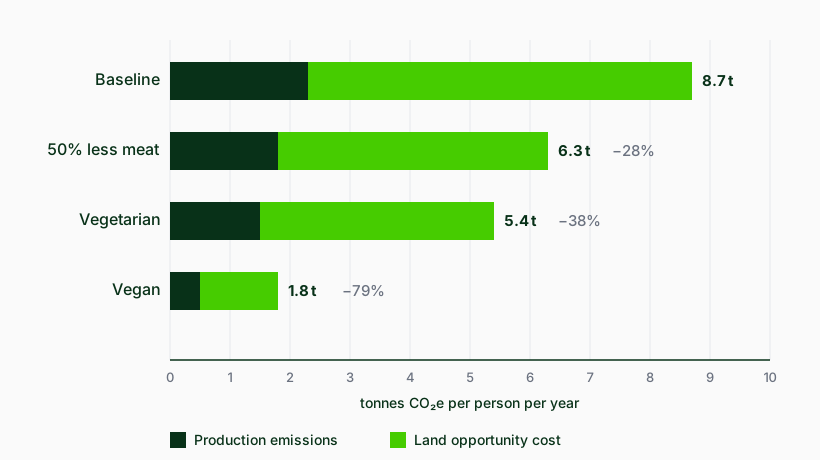
Four diet scenarios, both halves counted. Source: Searchinger et al., Nature 2018; per-diet breakdown by Bruck (2021).[2]
What the chart hides is the mechanism. Every lime-green segment that disappears as you move down the bars is a piece of land that no longer has to grow feed — and is free, physically, to do what it did for ten thousand years before we planted cows on top of it. Regrow. A hectare of pasture in a forest-potential climate, left alone, pulls carbon out of the atmosphere for decades. We already know this because forests have done it before. It is the most boring, best-documented climate technology on Earth.
Searchinger's paper names the step that makes the most of it happen. "Shifting consumption of ruminant meat and dairy to other foods would reduce emissions by 70%"[1]. Not meat in general — beef, lamb, and dairy in particular, because they use far more land per gram of protein than anything else on the menu. The vegan bar on the chart is 6.9 tonnes smaller than the baseline bar, and the entire difference is land returning to being land.
A reduction of that size is not a small number in a personal climate budget. To stay aligned with the Paris Agreement, the average person on Earth needs to emit around two tonnes per year by 2030 and close to zero by mid-century[3]. A high-income western footprint today is 8 to 11 tonnes across everything combined — food, flights, heating, cars, stuff. The gap that has to close is about seven tonnes per person. A single category of dietary shift closes most of it.
Why the labels don't show this yet
Every climate label you've ever seen on food, ours included, is using the conservative number. That isn't a flaw — it's a feature. Comparability across products requires a single agreed methodology, and Searchinger's correction isn't in the methodology yet. Climate labels, corporate disclosures and food regulation all sit on top of ISO-compliant Life Cycle Assessment, which deliberately excludes carbon opportunity cost so that every product is measured with the same ruler. Swap in Searchinger's number tomorrow and the ranking between two dishes wouldn't change; the scale on the side would just get larger. Standards move slowly for good reason.
Our own Climate Score is built on that same foundation, because it's the language kitchens, retailers and regulators speak, and it already includes the part of the land story the standards do cover: direct land-use change emissions, when a forest is cleared right now for cropland. What the standard omits is the forest that was cleared a century ago and never came back. That omission is what Searchinger measured, and more recent work confirms the direction: Hayek and colleagues, in PNAS in November 2024, found that even modest, targeted reductions in beef production on land that used to be forest could sequester ~125 gigatonnes of CO₂ globally[4].
The practical consequence for anyone reading a food label: the ranking is correct, the magnitude is understated. When a score tells you that swapping beef for lentils saves a kilo of CO₂, the real saving in the atmosphere — counting the forest that can grow back on the land you just freed — is several times that. Reading a food label well means treating the number as a lower bound.
The largest uncounted asset
Every other climate lever at individual scale has a payback period. A heat pump pays back in year seven, an electric car in year five, insulation in year ten. A dietary shift is the only seven-tonne lever on the table where the payback is negative — the cheaper basket at the grocery store almost always happens to be the one with less ruminant meat in it. There is no capital outlay, no technology waiting to be invented, no policy that first has to pass.
The land beneath dinner is the largest uncounted climate asset on the planet. The forests that could grow back on it are not a theoretical prize — they are the same forests that were there before we planted fodder on top of them. Getting some of that land back is not a sacrifice of the future. It is a restoration of the past, and it happens to be the cheapest climate lever any individual has access to.
Sources
- Searchinger, T. D., Wirsenius, S., Beringer, T. & Dumas, P. (2018). Assessing the efficiency of changes in land use for mitigating climate change. Nature 564, 249–253. doi.org/10.1038/s41586-018-0757-z. Quoted text and the 70% reduction finding are drawn from the authors' own companion explanation published by the World Resources Institute: explanation PDF (pages 2 and 8).
- Bruck, P. (2021). Ernährungswende als Klimaschutz. Per-diet breakdown (8.7 / 6.3 / 5.4 / 1.8 tCO₂e per person per year) derived from Searchinger et al. 2018. philipp-bruck.de/2021/02/ernaehrungswende-klimaschutz.
- IPCC (2022). Climate Change 2022: Mitigation of Climate Change. Working Group III contribution to the Sixth Assessment Report. Per-capita emissions pathways consistent with 1.5 °C are summarised in Chapter 2. ipcc.ch/report/ar6/wg3.
- Hayek, M. N. et al. (2024). Opportunities for carbon sequestration from removing or intensifying pasture-based beef production. Proceedings of the National Academy of Sciences 121(46). doi.org/10.1073/pnas.2405758121.
Ready to Transform Your Food Impact?
Discover how Eaternity can help your organization achieve sustainability goals.
Get Started