
100,000 Supermarket Products, Scored from Open Data
The EOS-Ayce Eurostars consortium has reached its first milestone: a public, methodology-grounded climate score for 100,000 European supermarket products, calculated from open data only. A research preview, available via the Flit demonstrator app.
100,000 Supermarket Products, Scored from Open Data
The EOS-Ayce Eurostars consortium has reached a big milestone: the climate scoring of 100,000 European supermarket products, derived from open data.
EOS-Ayce is a Eurostars-funded research consortium bringing together Eaternity, Klim and inoqo to develop the infrastructure for end-to-end environmental footprinting of food. Today, we've published phase 1 of this research project: Eaternity calculated the CO₂ impact of 100,000 European supermarket products using public inputs only (Open Food Facts plus public LCA references, no primary data). It establishes a public, peer-reviewable starting line.
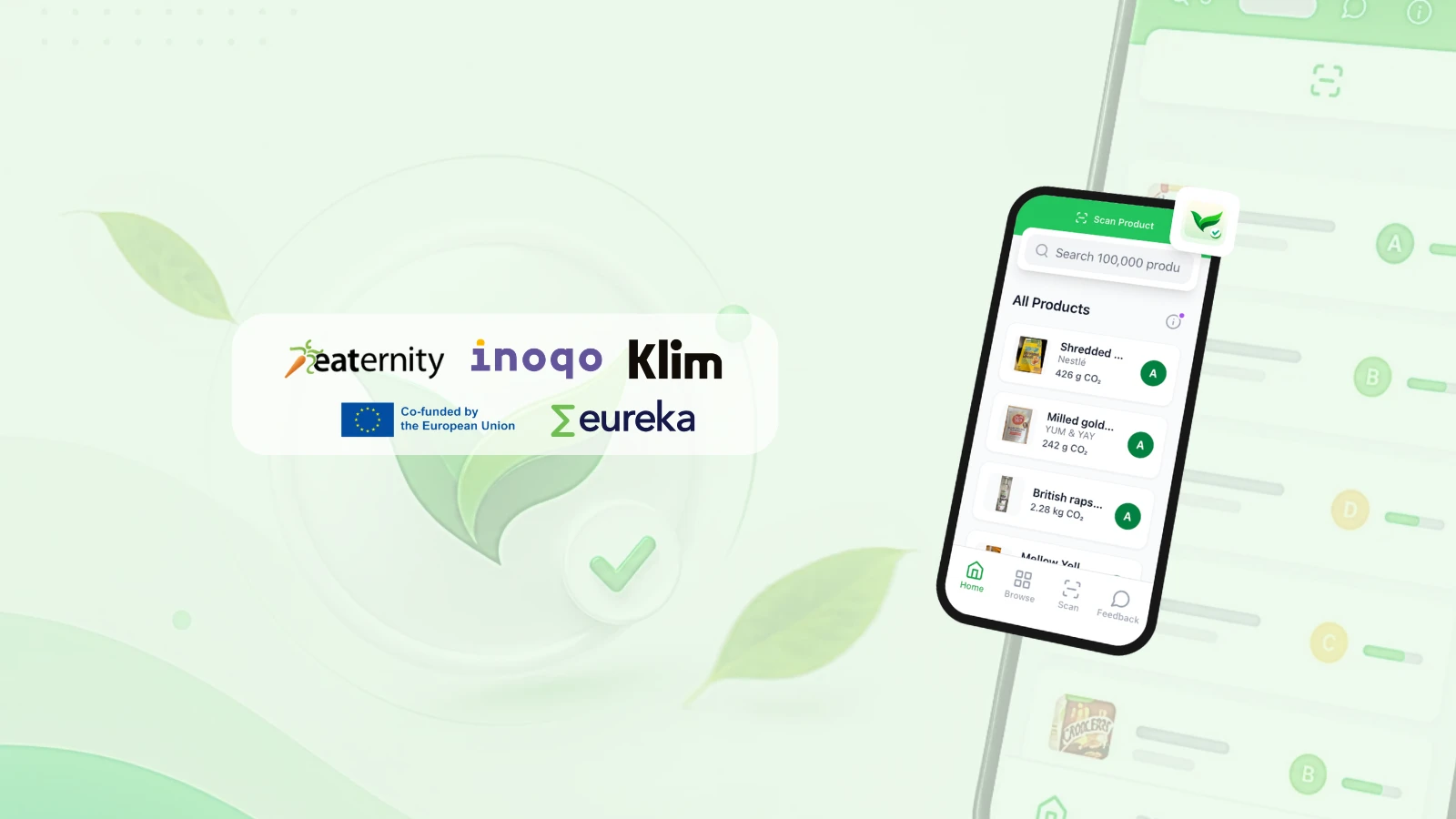
To make this data accessible, Eaternity has developed "Flit," a demonstrator app at flit.eaternity.org. The app enables reviewers to search and scan products to view the results. Each product includes an A–E rating and a CO₂e value, as well as a confidence score. The calculation engine is open-source at gitlab.com/eaternity/eos.
This milestone releases a public, methodology-grounded LCA baseline at a scale that, until now, hasn't openly existed. It's the foundation the rest of the project builds on.
How the 100K products were calculated
Inputs for the calculations come from Open Food Facts (barcode, ingredient list, nutrition, declared origin) and a stack of public LCA references (Agribalyse, BAFU/UVEK, the Eaternity Database, scientific literature). The EOS engine runs the rest: a gap-filling pipeline that solves for ingredient masses from declared nutrients, infers origin where labels are silent, geo-locates suppliers to FAO climate zones, models agricultural emissions per IPCC Tier 1, attaches transport and processing, and assembles a life-cycle inventory product by product.
How we handle uncertainty
Open Food Facts is user-contributed and label data carries gaps and inconsistencies. Rather than work around that, the release measures it: every product's inputs are scored for the uncertainty they introduce, and only products whose numbers stand up to that test are published. Products near a rating boundary, where a small input error could flip the letter, are held to a tighter tolerance than products well inside a band.
Some things cannot be inferred from label data (e.g. farming-system variation, seasonality, a specific supplier's actual practice) and this uncertainty is an inherent characteristic of any public-data approach. That's what we'll be working to resolve with the integration of primary data in phase 2.
What's next
Phase 2, in active development, brings primary data into the same engine and expands the product base. Klim's verified farm-level data flows in on a per-product basis, with explicit brand-client consent. The output is product-specific, auditable, and grounded in the actual supply chain rather than public estimates. Phase 2 is also where the methodology gets integrated into commercial and non-commercial applications by inoqo and Eaternity.
The EOS-Ayce Consortium
EOS-Ayce holds three partners with three complementary roles, each developing a different piece of the larger capability.
- Eaternity owns the methodology and the scoring engine, including the EOS pipeline, the curated inventory, the gap-filling modules, the benchmark.
- Klim is Europe's leading Scope 3 provider for the food sector, with 4,000+ farmers and 900,000+ hectares under an end-to-end insetting service aligned with SBTi FLAG and the GHG Protocol Land Sector guidance. Klim contributes verified, farm-level primary data in phase 2.
- inoqo is the retail-facing layer of the consortium — building the platform that translates farm-level and LCA data produced by Klim and Eaternity into actionable sustainability insights for retailers, while enabling suppliers to easily share primary data at scale through an intuitive supply chain engagement layer.
The May 2026 open release is issued by Eaternity on the basis of that joint work. EOS is open source at gitlab.com/eaternity/eos.
Questions or feedback?
See the FAQs on the Flit page for details on methodology, what the release does and does not represent, data ownership, and how to engage with us. Or contact us at hello@eaternity.ch.
EOS-Ayce (E!7949) is co-funded by Eurostars under the European Partnership on Innovative SMEs, with national funding from Innosuisse (Switzerland), BMBF (Germany) and FFG (Austria).
Ready to Transform Your Food Impact?
Discover how Eaternity can help your organization achieve sustainability goals.
Get Started