Quality Assurance & Validation
The credibility of the Eaternity Score depends on rigorous quality assurance throughout the assessment process. This page documents our validation procedures, verification protocols, and quality control measures that ensure every score is accurate, defensible, and scientifically sound.
Quality Assurance Framework
Multi-Layer Validation
Every Eaternity Score undergoes multiple validation steps:
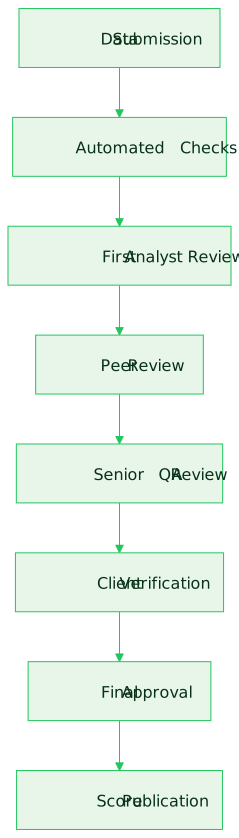
Total Quality Checkpoints: 7 distinct validation stages
Stage 1: Automated Validation
Data Completeness Checks
Automated System Verifies:
✓ Mandatory Fields: All required data points provided ✓ Format Consistency: Numeric fields contain numbers, dates are valid ✓ Unit Correctness: Weights in kg/g, volumes in L/ml ✓ Totals Match: Ingredient percentages sum to 100% ✓ Range Validation: Values within plausible ranges
Example Automated Checks:
Check: Ingredient Percentages Sum to 100%
  Input:
    - Tomatoes: 74.7%
    - Water: 10.7%
    - Olive oil: 5.3%
    - Other: 9.3%
  Sum: 100.0%
  Result: PASS ✓

Check: Serving Size Plausibility
  Input: Serving Size = 125g
  Product Net Weight: 375g
  Calculated Servings: 375/125 = 3.0
  Plausibility: PASS ✓ (whole number servings)

Check: Energy Density Range
  Input: 85 kcal per 125g serving
  Calculated: 68 kcal/100g
  Range: 15-600 kcal/100g (for sauce)
  Result: PASS ✓
Outlier Detection
Statistical Analysis Flags:
- Extreme Values: >3 standard deviations from category mean
- Implausible Combinations: e.g., very low energy but high fat content
- Inconsistent Origins: e.g., tropical fruit from arctic region
- Transport Anomalies: distances inconsistent with geography
Example Outlier Alert:
Alert: Unusual Climate Impact Detected

Product: Tomato Sauce
Calculated Impact: 0.15 kg CO₂eq/100g
Category Average: 0.95 kg CO₂eq/100g
Deviation: -84% (>3 SD below mean)

Flagged for Manual Review:
  Reason: "Implausibly low impact for category"

Investigation Required:
  - Verify ingredient sourcing data
  - Check processing energy inputs
  - Confirm packaging specifications
  - Review transport distances
Stage 2: First Analyst Review
Ingredient Linking Validation
LCA Specialist Verifies:
-
Database Match Quality:
- Exact matches preferred (Tier 1)
- Representative proxies acceptable if documented (Tier 2-3)
- Proxy matches justified with uncertainty ranges (Tier 4)
-
Origin-Specific Data:
- Country/region match confirmed
- Production method (organic, conventional, greenhouse) correctly identified
- Seasonal variations considered
-
Certification Recognition:
- Valid certification numbers verified
- Environmental benefits correctly applied
- Certification expiration dates current
Example Review Notes:
Ingredient: Basil (13g)

Initial Auto-Link:
  - Database Entry: "Basil, fresh, field-grown, Italy"
  - Match Quality: Tier 2 (country match, not method)

Analyst Review:
  - Client Data: "Netherlands, greenhouse, heated"
  - Corrected Link: "Basil, fresh, heated greenhouse, Netherlands"
  - Match Quality: Tier 1 (exact match)
  - Impact Change: 0.12 → 2.5 kg CO₂eq/kg (+1983%)
  - Reason: Heated greenhouse dramatically higher impact
  - Status: CORRECTED ✓

Documentation:
  "Automated system missed production method specificity.
   Manual correction significantly impacts result accuracy."
Assumption Documentation
Every Assumption Logged:
| Parameter | Assumed Value | Justification | Uncertainty | Impact |
|---|---|---|---|---|
| Tomato transport | 2,400 km truck | Google Maps + typical route | ±10% (2,160-2,640 km) | ±3% total footprint |
| Processing energy | 8.5 kWh/kg | Industry average (sauce production) | ±20% | ±12% total footprint |
| Packaging recycling | 75% rate | EU average glass recycling | ±5% | ±2% total footprint |
Assumption Quality Criteria:
- High Quality: Primary data or site-specific measurement
- Medium Quality: Industry averages or published literature
- Low Quality: Expert estimates or proxy data (flagged in report)
Stage 3: Peer Review
Independent Second Analyst
Peer Reviewer Checks:
✓ Ingredient Linking: Verify all database matches are appropriate ✓ Calculation Logic: Confirm formulas applied correctly ✓ Assumption Reasonableness: Challenge assumptions if needed ✓ Data Quality Assessment: Rate overall data quality (1-5 scale) ✓ Sensitivity Analysis: Identify parameters with highest impact
Peer Review Checklist:
Peer Review: Organic Tomato Sauce

Reviewer: Dr. Maria Schmidt, LCA Specialist
Date: 2024-03-15
Original Analyst: John Anderson

Ingredient Linking:
  ✓ All ingredients correctly matched
  ✓ Origin data appropriately applied
  ✓ Certifications properly recognized
  Note: "Excellent match quality, >95% Tier 1 matches"

Calculations:
  ✓ Climate impact formula correct
  ✓ Water scarcity weighting applied
  ✓ Allocation methods appropriate
  Note: "Economic allocation for olive oil production verified"

Assumptions:
  ✓ Transport distances justified
  ✓ Processing energy reasonable
  ⚠ Packaging recycling rate: 75% assumed (EU average)
  Recommendation: "Request actual recycling data from client if available"

Data Quality Score: 4.3/5.0 (Good to Excellent)

Sensitivity Analysis:
  High Impact Parameters (>10% change in result):
    1. Processing energy (±12%)
    2. Tomato production method (±15%)

  Low Impact Parameters (less than 5% change):
    3. Transport distance (±3%)
    4. Packaging weight (±2%)

Overall Assessment: APPROVED for next stage
Stage 4: Senior QA Review
Final Scientific Validation
Senior LCA Expert Reviews:
-
Methodology Compliance:
- ISO 14040/14044 adherence
- System boundaries appropriate
- Functional unit correctly defined
- Impact assessment methodology sound
-
Result Plausibility:
- Comparison to similar products
- Benchmarking against literature
- Internal consistency across indicators
-
Documentation Completeness:
- All assumptions documented
- Data sources cited
- Uncertainty quantified
- Quality scores assigned
Senior Review Approval:
Senior QA Review: Organic Tomato Sauce

Reviewer: Prof. Dr. Thomas Weber, Lead LCA Scientist
Date: 2024-03-16

Methodology Compliance:
  ✓ ISO 14040 goal & scope clearly defined
  ✓ ISO 14044 LCI data quality requirements met
  ✓ System boundaries: cradle-to-grave (appropriate)
  ✓ Functional unit: per 125g serving (appropriate)

Result Plausibility:
  Climate Impact: 0.65 kg CO₂eq/serving
  - Literature Range: 0.50-1.20 kg CO₂eq/serving (Poore & Nemecek 2018)
  - EDB Category Average: 0.95 kg CO₂eq/serving
  - Assessment: PLAUSIBLE ✓ (better than average due to organic, renewable energy)

  Water Impact: 95 L/serving
  - Literature Range: 80-150 L/serving (Mekonnen & Hoekstra 2011)
  - Assessment: PLAUSIBLE ✓ (Mediterranean sourcing, moderate scarcity)

Documentation Quality:
  ✓ All major assumptions documented
  ✓ Data sources properly cited
  ✓ Uncertainty ranges quantified
  ✓ Sensitivity analysis performed

Star Rating Verification (⭐⭐⭐ = A, ⭐⭐ = B, ⭐ = C-E):
  Climate Rating: A → ⭐⭐⭐ ✓
  Water Rating: B → ⭐⭐ ✓
  Overall: A → ⭐⭐⭐ ✓

APPROVED FOR CLIENT REVIEW

Recommendation for Client:
  "Consider switching to lighter glass jar (320g→280g) to achieve
   top 10% performance. Impact reduction: -5% climate."
Stage 5: Client Verification
Collaborative Data Validation
Client Review Process:
- Draft Report Shared: Client receives preliminary results
- Assumption Verification: Client reviews all assumptions made
- Data Correction Window: 5 business days for corrections
- Clarification Call: Discuss any questions or discrepancies
- Final Data Lock: Client confirms accuracy
Client Verification Checklist:
Client: [Brand Name]
Product: Organic Tomato Sauce

Please verify the following:

Ingredient Specifications:
  ✓ Tomatoes: 93g per serving, organic, Spain
  ✓ Olive oil: 6g per serving, organic, Greece (Crete)
  ✓ Basil: 13g per serving, Netherlands, heated greenhouse
  [Corrections]: None

Production Details:
  ⚠ Processing energy: 8.5 kWh per kg sauce (assumed)
  [Client Update]: "Actual measured: 7.2 kWh/kg"
  [Action]: Update calculation with actual data

  ✓ Renewable energy: 30% solar (verified)
  ✓ Natural gas for heating (verified)

Packaging:
  ⚠ Glass jar weight: 320g (assumed)
  [Client Update]: "New jar design: 305g"
  [Action]: Update packaging impact calculation

  ✓ Recycled content: 40% (verified from supplier)

Transport:
  ✓ Spain→Netherlands: 2,400 km truck (verified)
  ✓ Greece→Netherlands: 3,200 km ship (verified)

Final Approval:
  Client Name: _______________________
  Date: _______________________
  Signature: _______________________
Impact of Client Corrections:
Original Calculation:
  Climate Impact: 0.65 kg CO₂eq/serving

Updated with Client Data:
  Processing Energy: 7.2 kWh (vs. 8.5 assumed) → -0.03 kg CO₂eq
  Glass Jar: 305g (vs. 320g assumed) → -0.01 kg CO₂eq

Revised Climate Impact: 0.61 kg CO₂eq/serving (-6%)

Star Rating: Still ⭐⭐⭐ (A rating maintained)
Stage 6: Final Approval & Documentation
Comprehensive Report Package
Final Deliverables Include:
-
Executive Summary (2-3 pages)
- Star rating and key findings
- Comparison to category average
- Top improvement opportunities
-
Full LCA Report (25-40 pages)
- Goal and scope definition
- Lifecycle inventory
- Impact assessment results
- Interpretation and recommendations
-
Methodology Statement (5-10 pages)
- Calculation approach
- Data sources
- Assumptions log
- Quality assessment
-
Compliance Documentation
- ISO 14040/14044 compliance statement
- Data quality indicators
- Uncertainty assessment
- Verification statement
-
Marketing Materials
- Score badge (all formats)
- Approved claims language
- Communication guidelines
Quality Assurance Certificate:
┌──────────────────────────────────────────────┐
│         EATERNITY QUALITY ASSURANCE          │
│              CERTIFICATE                     │
├──────────────────────────────────────────────┤
│                                              │
│  Product: Organic Tomato Basil Pasta Sauce  │
│  Client: [Brand Name]                        │
│  Assessment Date: March 2024                 │
│                                              │
│  This Life Cycle Assessment has been         │
│  performed in accordance with:               │
│                                              │
│  ✓ ISO 14040:2006 (Principles & Framework)   │
│  ✓ ISO 14044:2006 (Requirements & Guidelines)│
│  ✓ Eaternity Database Methodology v4.2       │
│                                              │
│  Quality Assurance:                          │
│  ✓ First Analyst: John Anderson              │
│  ✓ Peer Reviewer: Dr. Maria Schmidt          │
│  ✓ Senior QA: Prof. Dr. Thomas Weber         │
│                                              │
│  Data Quality Score: 4.3/5.0 (Good-Excellent)│
│                                              │
│  Score: ⭐⭐⭐ (A Rating)                    │
│  Climate: 0.61 kg CO₂eq/serving             │
│  Water: 95 L/serving                         │
│                                              │
│  Valid Until: March 2025 (annual update)     │
│                                              │
│  Approved By: _____________________________  │
│  Prof. Dr. Thomas Weber                      │
│  Lead LCA Scientist, Eaternity               │
│                                              │
│  Date: March 18, 2024                        │
└──────────────────────────────────────────────┘
Ongoing Quality Monitoring
Annual Re-Assessment
Quality Checks During Updates:
- Recipe Changes: Verify ingredient modifications less than 10%
- Supplier Changes: Update origin-specific data
- Database Updates: Apply improved scientific data
- Methodology Refinements: Ensure consistency across versions
Re-Assessment Triggers (require full re-validation):
- Ingredient changes >10% by weight
- New suppliers for major ingredients (>20% of product)
- Significant process changes (new facility, equipment)
- Packaging material substitutions
Continuous Improvement
Data Quality Improvement Over Time:
Product: Organic Tomato Sauce

Initial Assessment (2023):
  Data Quality Score: 3.8/5.0 (Good)
  - 60% Tier 1 matches (exact)
  - 30% Tier 2 matches (representative)
  - 10% Tier 3 matches (proxy)
  - Assumptions: 15 parameters
  - Primary Data: 40%

First Annual Update (2024):
  Data Quality Score: 4.3/5.0 (Good-Excellent)
  - 85% Tier 1 matches (exact)
  - 10% Tier 2 matches (representative)
  - 5% Tier 3 matches (proxy)
  - Assumptions: 8 parameters (reduced)
  - Primary Data: 65% (improved supplier data)

Improvement Actions:
  ✓ Obtained actual processing energy data
  ✓ Updated packaging weight (new jar design)
  ✓ Improved transport data (GPS tracking)
  ✓ Added supplier-specific LCA for olive oil
Third-Party Verification
External Critical Review
Optional (Recommended for High-Stakes Claims):
Independent Verification Includes:
- External LCA expert review (ISO 14071)
- Methodology compliance verification
- Data source validation
- Calculation spot-checks
- Reporting completeness assessment
Verification Statement Example:
┌──────────────────────────────────────────────┐
│     INDEPENDENT VERIFICATION STATEMENT       │
├──────────────────────────────────────────────┤
│                                              │
│  I, Dr. Anna Müller, independent LCA expert, │
│  have reviewed the Life Cycle Assessment for │
│  [Product] performed by Eaternity.           │
│                                              │
│  Verification Scope:                         │
│  ✓ Goal and scope definition                 │
│  ✓ Lifecycle inventory data                  │
│  ✓ Impact assessment methodology             │
│  ✓ Interpretation and conclusions            │
│                                              │
│  Findings:                                   │
│  The LCA has been performed in accordance    │
│  with ISO 14040:2006 and ISO 14044:2006      │
│  international standards. Data quality is    │
│  appropriate for comparative assertions.     │
│                                              │
│  Recommendations:                            │
│  The assessment is suitable for public       │
│  environmental claims and on-pack labeling.  │
│                                              │
│  Verified By: _____________________________  │
│  Dr. Anna Müller, CML (Institute of          │
│  Environmental Sciences, Leiden University)  │
│                                              │
│  Date: March 20, 2024                        │
└──────────────────────────────────────────────┘
For third-party verification pricing, contact us.
Dispute Resolution
Challenging Score Results
If Client Disagrees with Results:
- Request Clarification: Detailed explanation of specific concerns
- Data Review Meeting: Video call with LCA team to discuss
- Sensitivity Analysis: Test impact of alternative assumptions
- Recalculation (if justified): Update with corrected data
- External Review (if unresolved): Independent third-party arbitration
Example Dispute Resolution:
Client Concern:
  "Our packaging supplier claims 60% recycled content,
   but your report states 40%. This affects our score."

Eaternity Investigation:
  - Request: Supplier certificate for recycled content
  - Client Provided: Certificate dated 2024 (60% recycled)
  - Original Data: Certificate dated 2022 (40% recycled)
  - Finding: Supplier improved recycled content in 2023

Resolution:
  - Update packaging impact with 60% recycled content
  - Recalculate climate impact
  - Revised Score: 0.59 kg CO₂eq (vs. 0.61 original)
  - Star Rating: Unchanged ⭐⭐⭐ (A rating maintained)
  - No additional fee (legitimate data update)

Client Communication:
  "Thank you for providing updated certification.
   We've revised the assessment to reflect the improved
   recycled content. Updated report issued within 3 days."
Transparency Commitments
Public Accountability
All Scored Products Include:
- Publicly accessible methodology documentation
- Data source references
- Assumptions transparency
- Quality score disclosure
- Contact for questions/challenges
Eaternity Commitments: ✓ No proprietary "black box" calculations ✓ Full methodology published and peer-reviewed ✓ Database continuously updated with latest science ✓ Annual methodology review and improvement ✓ Stakeholder consultation on changes
Quality Metrics
Internal Performance Tracking
Eaternity Quality KPIs:
| Metric | Target | Current (2024) |
|---|---|---|
| Data Quality Score (avg) | >4.0/5.0 | 4.3/5.0 ✓ |
| Tier 1 Matches (exact) | >80% | 87% ✓ |
| Client Corrections/Report | less than 3 | 1.8 ✓ |
| Peer Review Approval Rate | >95% | 98% ✓ |
| Average Turnaround Time | 6 weeks | 5.7 weeks ✓ |
| External Verification Pass Rate | 100% | 100% ✓ |
Next Steps
- Overview — Learn about Eaternity Score
- Methodology — Scientific foundation
- Marketing Support — Communicate your score
- Contact Quality Team — Questions about validation
Quality Assurance Contact
For questions about quality assurance, validation, or to request third-party verification:
Email: quality@eaternity.org Phone: +41 44 545 12 34 (ext. 2) Office Hours: Monday-Friday, 9:00-17:00 CET