EOS Core
The EOS Core is the calculation system that powers all Eaternity products. It transforms incomplete food data into comprehensive environmental impact assessments through a sophisticated system of Gap Filling Modules (GFMs).
What is EOS Core?
EOS Core is a graph-based calculation framework designed to:
- Fill data gaps in food product information using scientific models
- Calculate environmental impacts across multiple dimensions (climate, water, biodiversity)
- Generate ratings and scores that communicate impact to consumers
- Scale efficiently from single products to millions of SKUs
Core Capabilities
Environmental Impact Assessment
The engine calculates impacts across multiple environmental dimensions:
| Dimension | Unit | Description |
|---|---|---|
| Climate | kg CO₂e | Greenhouse gas emissions |
| Water | liters | Blue water footprint |
| Biodiversity | points | Land use impact on ecosystems |
| Animal Welfare | rating | Husbandry conditions assessment |
| Rainforest | m² | Deforestation risk |
Data Gap Filling
Real-world food data is often incomplete. The engine automatically fills gaps using:
- Default values from scientific databases
- Proxy calculations based on similar products
- AI-powered matching for ingredient identification
- Rule-based inference from available attributes
Scalable Architecture
The engine processes data at multiple scales:
Single Product → Recipe Analysis → Menu Assessment → Portfolio Scoring
     ↓              ↓                  ↓                  ↓
   1 item      10-50 items       100s of items      1000s of SKUs
How It Works

- Input Data - Raw product information (name, ingredients, origin, etc.)
- Graph Creation - Build calculation graph with nodes for products, ingredients, and processes
- GFM Scheduling - Orchestrator determines which modules should run on which nodes
- Module Execution - GFMs fill gaps and calculate impacts in dependency order
- Impact Calculation - Aggregate environmental footprints across lifecycle stages
- Rating Generation - Transform impacts into user-friendly scores
- Output - Structured results ready for display or integration
System Architecture
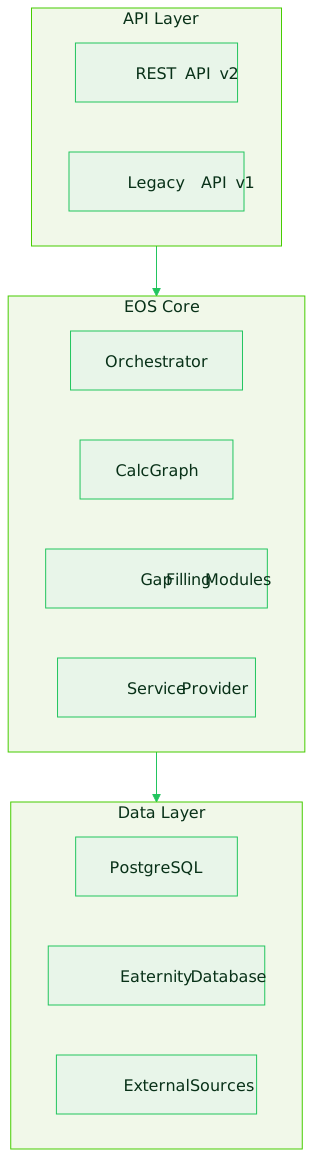
Key Components
Calculation Graph (CalcGraph)
The central data structure managing calculations as a directed graph:
- Nodes represent entities (products, ingredients, processes, emissions)
- Properties store immutable data on nodes
- Mutations provide transparent, auditable graph changes
- Observers trigger GFM execution when nodes are added
Gap Filling Modules (GFMs)
The engine's modularity comes from its 50+ specialized GFMs:
| Category | Examples |
|---|---|
| Matching | match_product_name_gfm, AI-powered ingredient matching |
| Location | origin_gfm, location_gfm, geographic handling |
| Lifecycle | greenhouse_gfm, transportation_gfm, processing_gfm |
| Environmental | impact_assessment_gfm, water_scarcity_gfm, rainforest_gfm |
| Aggregation | aggregation_gfm, combining results across ingredients |
Orchestrator
The orchestrator coordinates GFM execution:
- Spawns workers for each node via Factory pattern
- Checks
should_be_scheduled()to determine relevance - Verifies
can_run_now()for dependency satisfaction - Executes modules asynchronously with priority management
- Handles errors and tracks performance statistics
Learn more about orchestration →
Methodology Foundation
All calculations are grounded in peer-reviewed scientific methodology:
- Life Cycle Assessment (LCA) principles
- Database partnerships (ecoinvent, WFLDB)
- Transparent assumption documentation
- Regular scientific review
Learn more about Methodology →
Integration Options
EOS Core can be accessed through:
| Integration | Use Case | Description |
|---|---|---|
| Eaternity API v2 | Full-featured API | Modern REST API with batch processing |
| Eaternity API v1 | Legacy compatibility | Backward-compatible endpoints |
| GFM SDK (coming soon) | Custom modules | Build and deploy custom GFMs |
Next Steps
- Technical Deep Dive - Detailed system design
- How It Works - Step-by-step calculation flow
- Gap Filling Modules - Module system details